
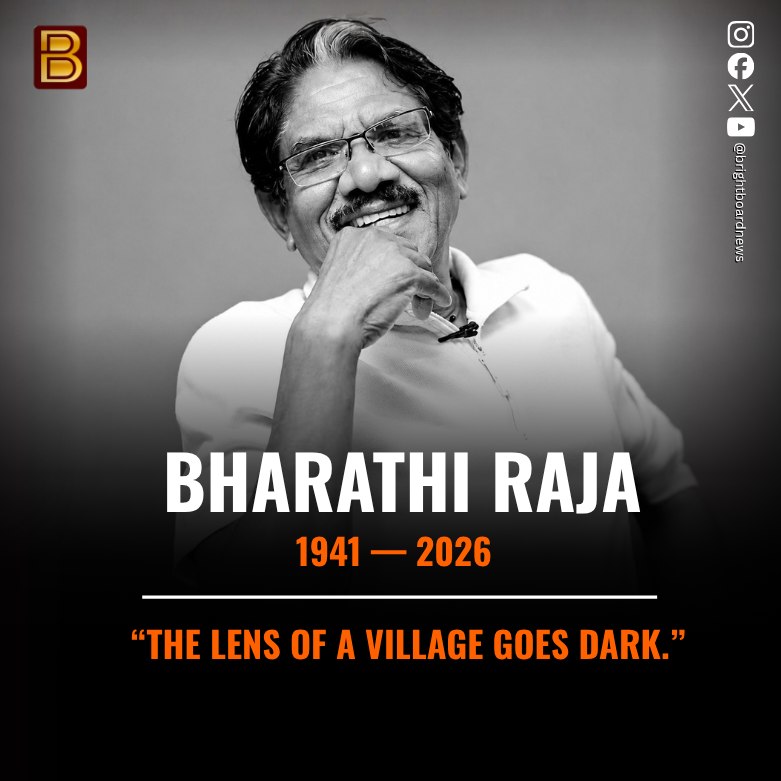
The Lens of a Village Goes Dark — Tamil Cinema Loses Its Soul
“Bharathiraja, the director who dragged Tamil films out of studio sets and into the red soil of rural India, is gone at 84 leaving behind a legacy that no sequel can replicate.”
A Legend Departs
Tamil cinema bid farewell to a legendary filmmaker on Wednesday as Bharathiraja passed away in Chennai at the age of 84 after battling age-related health issues. Born as Chinnasamy Periyamaya Thevar in Allinagaram, Theni district, he revolutionized Tamil cinema by bringing authentic rural stories, landscapes, and characters to the big screen. The Tamil Film Producers Council confirmed his death, describing him as one of the industry’s most respected veterans and a former president of the council. Bharathiraja had been hospitalized several times since late 2025 due to breathing-related complications. His final months were marked by personal tragedy as well, following the death of his son, Manoj Bharathiraja, from cardiac arrest in March 2025. Tributes from filmmakers, actors, politicians, and fans have poured in, honoring a director whose work forever changed the landscape of Tamil cinema.
From Theni to the Silver Screen
Bharathiraja did not arrive in cinema through the usual corridors of privilege. He grew up in the agricultural heartland of what is now Theni district, absorbing the textures of rural Tamil life the mud-walled homes, the seasonal floods, the unwritten social codes that would later define every frame he put on screen. He married Chandraleela in 1974 and spent his early years learning the craft from the margins, building toward a debut that would rewrite the rules of the industry entirely. When he finally walked onto a film set as a director, he did not come as a stylist or a mythologist. He came as a storyteller who knew the smell of the earth his characters walked on. That sensibility rooted, honest, and stubbornly anti-glamorous made him an outlier in a Tamil film world that was still largely drunk on studio fantasy. He would spend the next four decades proving that the outlier was, in fact, the mainstream that had simply not been discovered yet.
The Film That Changed Everything
In September 1977, a low-budget Tamil film with a cast of largely unknown faces released to quiet expectations. 16 Vayathinile shot on a budget of just ₹5 lakh turned into a cultural earthquake. Starring Kamal Haasan, Rajinikanth, and Sridevi in their formative years, the film told the story of a sixteen-year-old girl caught between two men against the backdrop of a village landscape that felt less like a set and more like documentary footage. It won Kamal Haasan the Filmfare Best Actor (Tamil) award, earned S. Janaki a National Film Award for Best Female Playback Singer, and took home four Tamil Nadu State Awards including Best Director for Bharathiraja himself. More than any trophy, it gave Tamil cinema a new vocabulary one written in the dialect of the countryside rather than the grammar of the studio. The film is now considered a cult classic, credited with triggering a wave of realistic rural cinema that reshaped the industry’s aesthetic for a generation. Ilaiyaraaja’s music for the film composed with characteristic restraint and folk influence cemented a creative partnership between the two men that would go on to produce some of the most beloved soundscapes in Tamil film history.
A Filmography Written in Red Soil
Over four decades, Bharathiraja directed more than 40 films a body of work that defies easy summary but shares a consistent heartbeat. Kizhake Pogum Rail brought the railway and its migrant workers into the frame of rural poetry. Sigappu Rojakkal gave Tamil cinema one of its first genuinely disturbing psychological thrillers, with Kamal Haasan delivering a performance that still unsettles. Alaigal Oivathillai captured the desperation of young love with an emotional intensity rarely matched before or since. Mudhal Mariyathai, his 1985 National Award winner, gave dignity to a middle-aged love story in a cinematic landscape that rarely bothered with such things. Karuththamma, his 1994 collaboration with composer A.R. Rahman, returned to the sea-facing villages of Tamil Nadu with a story of caste, desire, and consequence that earned both critical and commercial recognition. His final directorial work was Paravai Kootil Vaazhum Maangal, a segment in Prime Video’s anthology series Modern Love Chennai. His final screen appearance as an actor came in Mohanlal’s Thudarum, proving that the man had never truly stopped working only slowed, the way a river does before it meets the sea.
The Titles He Earned and the Nation That Recognised Him
Tamil cinema’s own vocabulary ran out of sufficient superlatives for Bharathiraja long ago. The industry settled on calling him Iyakkunar Imayam, The Himalaya of Directors an honorific that speaks less to altitude and more to permanence. His awards list spans multiple National Film Awards, a clutch of Tamil Nadu State Film Awards, several Filmfare South honours, and the Padma Shri in 2004, when the Government of India formally acknowledged what Tamil audiences had known for nearly three decades. He also served as president of the Tamil Film Producers Council, bringing to institutional roles the same seriousness he brought to storytelling. He trained generations of filmmakers through his working method by doing, by insisting on location shoots when studios were cheaper, by casting faces that reflected reality rather than projection. Actors including Kamal Haasan, Rajinikanth, Sridevi, and many others took their earliest major steps under his direction. Cinematographer B. Kannan worked so closely with him that he was referred to as “Bharathirajavin Kangal” Bharathiraja’s Eyes.
A State Mourns, An Industry Grieves
Tamil Nadu’s government moved swiftly. Chief Minister Vijay announced that the state would accord Bharathiraja a ceremonial farewell, a recognition befitting a man whose films documented the state’s villages with more accuracy and affection than most government surveys. Actor-politician Khushbu Sundar described his death as a shadow over Tamil cinema, noting that his films had set the standard by which all other filmmakers in the genre measured themselves. Pawan Kalyan and other film industry figures from across the country posted tributes that spoke of a loss not just to Tamil cinema but to Indian storytelling as a whole. Bharathiraja is survived by his wife Chandraleela and his daughter Janani. He leaves behind a filmography that does not merely entertain it witnesses. Every frame he put together was a small act of documentation: proof that the villages existed, that the people in them had loves and losses worth watching, and that cinema, at its most honest, does not need a stage. It only needs a truth to tell. Tamil cinema will keep telling stories. But it will take a long time before it finds another pair of eyes that sees the way Bharathiraja did.