
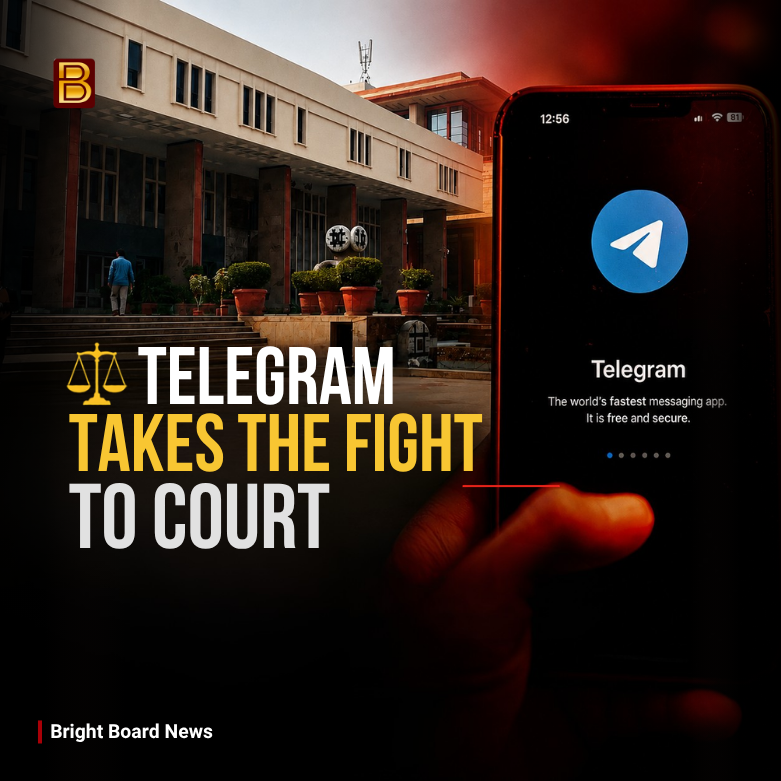
TELEGRAM VS THE STATE: MESSAGING GIANT DRAGS INDIA’S NEET BAN TO DELHI HIGH COURT
Platform calls blanket restriction disproportionate as 150 million users lose access days before the re-examination
When Silence Was Ordered — And Telegram Refused
On the morning of June 17, 2026, millions of Indians opened their phones only to find Telegram missing not crashed, not slow, but deliberately removed. The app had vanished from Google Play and the Apple App Store. Telecom operators had quietly throttled access overnight. India had, without public fanfare, switched off one of the world’s most widely used communication platforms. By afternoon, Telegram had filed an urgent petition before the Delhi High Court, refusing to go quietly.
The Government’s Move: Section 69A and a Seven-Day Window
On Tuesday, June 16, the Central Government invoked Section 69A of the Information Technology Act, 2000, to restrict access to Telegram across
India until June 22. The window was not random it covers the NEET-UG 2026 re-examination scheduled for June 21 and its immediate aftermath. The Ministry of Electronics and Information Technology (MeitY) acted on formal recommendations from the National Testing Agency and the Department of Higher Education, both of which flagged that channel-by-channel content removal had proven insufficient in stopping the flood of fraudulent exam material circulating on the platform. MeitY described the move as a measure of last resort, taken only after intermediate remedies including coordinated takedown action had been pursued and had not produced results at the platform level. Within hours of the order, both Google and Apple removed Telegram from their app stores, cutting off new downloads entirely.
What NTA Found on Telegram
The National Testing Agency’s complaint was not vague. It named specific channels operating openly on the platform with names designed to alarm and exploit: “PAPER LEAKED NEET,” “Re-NEET 2026,” “Private Mafia,” and “REE NEET MAFIAA” all of which demanded sums ranging from a few thousand to several lakhs of rupees in exchange for purported access to the re-examination paper. Yet the NTA itself was blunt about the nature of these rackets: “There is no such paper available outside the secured examination chain. The promise of any such material is, in every instance, a fraud,” the agency stated. The channels were not selling real exam papers they were running scams that preyed on desperate students and their families. Still, the agency argued their continued operation constituted a threat to the integrity of the examination process.
Telegram Fights Back: Urgent Petition Before Justice Tejas Karia
Telegram approached the Delhi High Court on an urgent basis, with Advocate Madhav Khosla mentioning the matter before a vacation bench of Justice Tejas Karia. The court agreed to hear the plea the same day. Telegram’s central argument is one of proportionality that shutting down an entire platform with over 150 million users in a single country to address misconduct by a fraction of its user base is a legal overreach that punishes the innocent far more than it inconveniences the guilty. New Kerala. The company is expected to argue that targeted action against individual violators would be more appropriate and effective than a blanket suspension affecting the entire platform. With the re-test less than four days away, Telegram urged the High Court to intervene before June 21.
Pavel Durov Speaks Out: “This Punishes the Wrong People”
Telegram’s founder Pavel Durov did not limit his response to legal filings. Taking to X on June 16, Durov mounted a public defence of his platform and a pointed criticism of India’s decision. He acknowledged that over the preceding weeks, Telegram had removed hundreds of channels sharing leaked exam materials and related scams in India. But he argued the government’s action had achieved nothing it set out to do.
“The ban hasn’t stopped anything. The leaks just moved to other apps,” Durov wrote. He framed the restriction as a misdirected punishment: India’s IT ministry had banned Telegram because some users shared leaked exam questions, but this penalises over 150 million ordinary users, not the insiders who actually leaked the material. His conclusion was unambiguous “Telegram is a force for good. Banning it, even temporarily, is a mistake.”
The Larger Question: Platform Liability vs. User Accountability
This case lands at the heart of a debate that has troubled digital regulators worldwide. When harmful content spreads on a platform, who is responsible the platform that hosts it, or the individuals who create and share it? India’s government has drawn a firm line, arguing that when a platform fails to remove harmful content at scale, the platform itself must be held to account.
Telegram counters that it acted in good faith by removing offending channels, and that a nationwide ban crosses into territory that violates both free expression and the rights of millions of law-abiding users. The Delhi High Court’s ruling, expected before the June 21 re-test, will set a significant precedent for how India balances exam security with the digital rights of its citizens.
What Happens Next
The outcome of the hearing could carry significant implications for both exam-security policy and the government’s broader approach to regulating digital platforms. If the court upholds the ban, it signals that temporary platform-wide restrictions are a legally acceptable emergency measure. If it rules in Telegram’s favour, it may force regulators to demonstrate more granular, targeted approaches to content enforcement a standard that will outlast this particular exam cycle. The Free Press Journal. Either way, the NEET-UG 2026 controversy has once again exposed the fault lines between institutional exam integrity and the realities of an interconnected digital society where banning one door rarely keeps determined actors from finding another.