
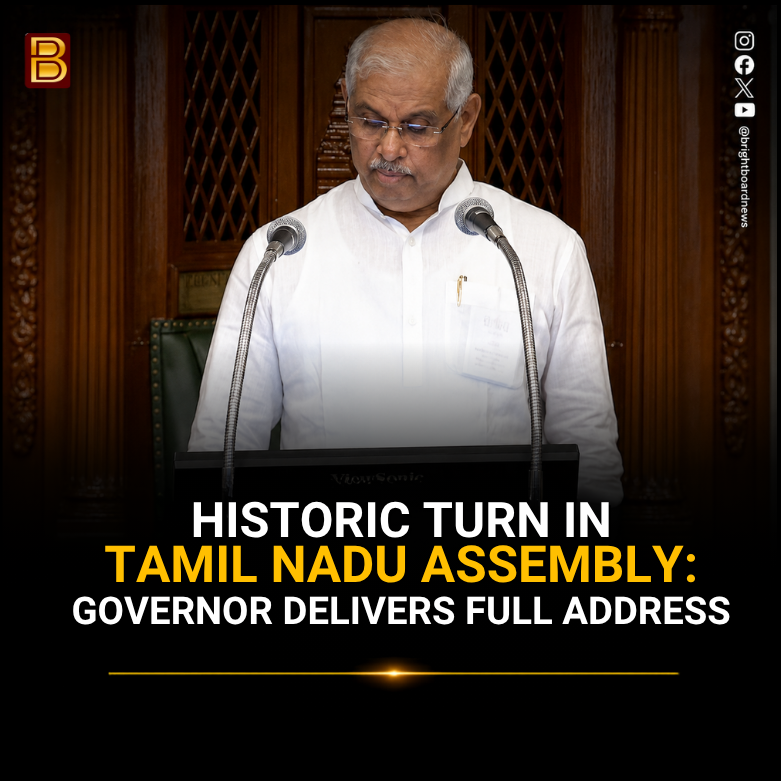
Tamil Nadu Assembly Begins New Chapter: Full Governor’s Address, Black-Badge Protest, and the Government’s First Political Test
A New Political Landscape Shaped by the People’s Verdict
Tamil Nadu’s newly elected government has commenced its first Legislative Assembly session, marking the beginning of a new political era in the state. Formed on the strength of the mandate delivered by voters in the 2026 Assembly elections, the government has pledged to prioritize economic growth, job creation, welfare initiatives, and administrative reforms. As the first Assembly session of the new administration, the proceedings attracted significant political attention. Observers viewed the session as an early indicator of how the government intends to implement its electoral promises and navigate the challenges ahead.
Governor’s Address Highlights Growth, Governance, and Development
The Assembly session opened with Governor R.N. Ravi Arlekar delivering the government’s policy address. The speech outlined the administration’s priorities, including economic development, industrial investment, employment generation, educational advancement, women’s empowerment, and social welfare programs. The Governor also highlighted major issues facing the state, such as fiscal challenges, water resource management, infrastructure development, and law-and-order concerns. The address emphasized the government’s commitment to steering Tamil Nadu toward sustainable growth while addressing long-standing structural challenges. The policy statement served as the administration’s first formal roadmap, providing legislators and the public with a glimpse of its vision for the coming years.
Historic Moment: Governor’s Address Read in Full After Four Years
One of the most significant aspects of the session was that the Governor’s address was read in its entirety something that had not occurred in the Tamil Nadu Assembly for the past four years. In previous years, disagreements and political tensions surrounding the Governor’s speech often dominated headlines, leading to procedural controversies and debates. As a result, the complete reading of the address became a notable development in this year’s proceedings.Political analysts have described the event as a symbolic moment, reflecting a more stable institutional environment and a renewed commitment to legislative conventions. The full reading of the address ensured that the government’s policy agenda was officially placed on record without interruption, giving the session added historical significance.Many observers believe this development signals a shift toward a more structured relationship between constitutional authorities and the elected government, at least in the early stages of the new administration.
Governor Praises the Government’s Democratic Mandate
During the proceedings, remarks attributed to the Governor emphasized that the current administration emerged through the clear will of the people. Supporters of the government interpreted the comments as recognition of the strong democratic mandate delivered by voters. The statement was widely discussed in political circles, with ruling party leaders viewing it as an acknowledgment of public confidence in the new administration. The remarks further fueled debate over the significance of the electoral outcome and the expectations that accompany such a mandate. For the government, the praise also serves as a reminder that public trust must be matched by performance, policy delivery, and effective governance.
Opposition Stages Black-Badge Protest Inside the Assembly
The first day of the Assembly session was not without confrontation. Members of the opposition DMK entered the House wearing black badges as a mark of protest. Led by Opposition Leader Udhayanidhi Stalin, the protest was aimed at drawing attention to issues the party believes require urgent government intervention. Opposition members alleged deterioration in law and order and expressed concern over crimes against women and public safety. The symbolic protest quickly became one of the defining images of the opening day, drawing extensive media attention and setting the tone for a potentially combative Assembly session. Political observers noted that the demonstration signaled the opposition’s intent to aggressively scrutinize the government from the very beginning of its tenure.
Udhayanidhi Stalin Raises Key Questions for the Government
Opposition Leader Udhayanidhi Stalin used the opening session to question the government on several fronts, particularly regarding the implementation of election promises. He sought clarity on timelines for major welfare schemes, employment initiatives, women’s safety measures, and other commitments made during the election campaign. According to the opposition, voters deserve a clear roadmap outlining when and how these promises will be fulfilled. The opposition also highlighted various administrative and governance challenges that have emerged in the early days of the new government. These concerns are expected to form the basis of detailed debates in the coming sessions.The questions raised by the opposition indicate that accountability and policy execution are likely to dominate Assembly discussions in the months ahead.
Three-Day Session Becomes the Government’s First Major Political Test
The Assembly session is scheduled to continue for three days, during which legislators will debate the Governor’s address, discuss policy priorities, and raise issues affecting the people of Tamil Nadu. For the government, the session represents its first major political examination. Citizens will be looking for concrete plans, implementation strategies, and assurances that campaign promises will translate into action. At the same time, the opposition appears determined to challenge the administration on governance, law and order, and policy execution. The combination of a historic full Governor’s address, strong political messaging from the ruling side, and a visible protest from the opposition has ensured that the session begins with considerable intensity. As debates unfold over the coming days, the Assembly is expected to provide a clearer picture of the government’s governing style, legislative priorities, and ability to deliver on public expectations. More than a routine parliamentary exercise, this first session has become a defining moment that could shape Tamil Nadu’s political trajectory for years to come.