
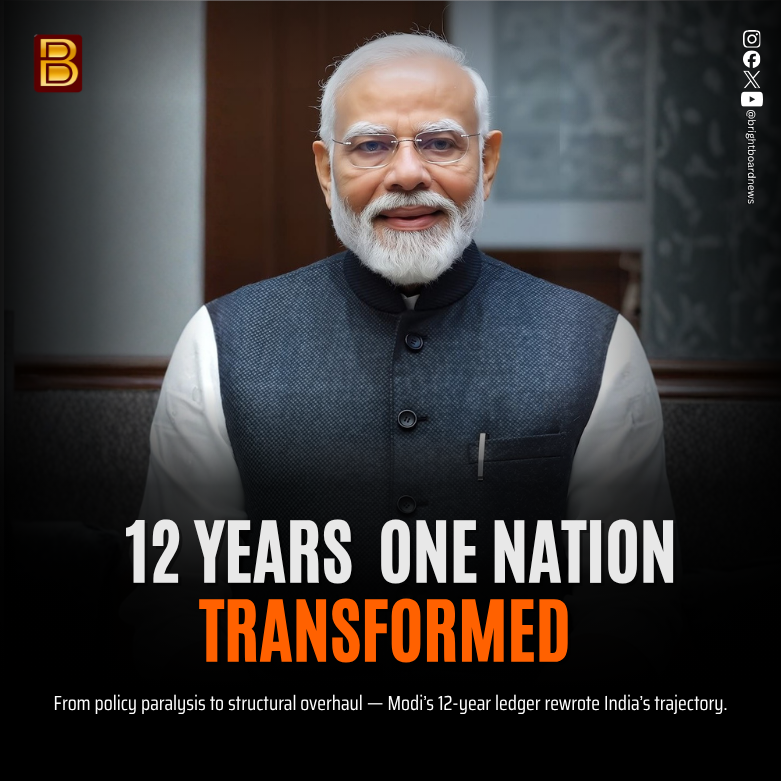
12 Years, One Nation: How Modi Rewrote India’s Story
“A decade-plus of bold governance — from silent villages getting bank accounts to the world watching India’s digital payments in awe. Here is what changed”
The Man Who Took the Chair When India Was Ranked 11th
When Narendra Modi walked into South Block on May 26, 2014, India was the world’s eleventh-largest economy — a nation of immense potential held back by policy paralysis, subsidy leakages, and a collapsing confidence in governance. Twelve years later, that same nation stands at fourth place globally, and the distance between those two numbers tells the story of the most consequential stretch of Indian governance since Independence. The journey was not without friction, controversy, or unfinished business — but the scale of structural transformation that unfolded between 2014 and 2026 is difficult to dispute.
One Tax, One Nation — And the Long Road to GST
The single most disruptive economic reform of the Modi era arrived on the midnight of July 1, 2017, when the Goods and Services Tax replaced a
labyrinth of state and central levies that had long fractured India’s domestic market. Traders, small businesses, and accountants across the country struggled through the initial rollout — the compliance portal crashed, the tax slabs drew criticism, and small manufacturers felt cornered. But the macro architecture held. A unified national market began to take shape, inter-state movement of goods became cheaper and faster, and tax revenues climbed steadily over subsequent years. GST was imperfect by design and messy in execution — but it was structurally irreversible, and that alone made it historic.
A Phone, A Fingerprint, A Bank Account — India’s JAM Revolution
Before 2014, hundreds of millions of Indians were invisible to the formal financial system. The Modi government’s answer was the JAM Trinity — Jan Dhan accounts linked to Aadhaar biometrics, riding on mobile connectivity. By March 2026, Jan Dhan accounts had surged to 577.1 million, while over 1.44 billion Aadhaar numbers had been issued, deeply woven into daily life. Welfare money that once leaked through multiple middlemen began arriving directly in beneficiary accounts. Women in remote villages opened their first bank accounts. The architecture was imperfect — exclusion errors hurt vulnerable populations — but the financial inclusion footprint it created was genuinely unprecedented at this scale and speed. Organiser WeeklyOrganiser Weekly
UPI: The Quiet Revolution That Went Global
No single product of the Modi era has earned more international admiration than the Unified Payments Interface. In May 2026 alone, UPI processed 23.2 billion transactions worth nearly ₹30 lakh crore — numbers that once seemed fantastical for a country where cash was king. The system allowed street vendors and small traders without bank accounts to receive payments via digital wallets, and enabled near-instant money transfers to distant relatives — transactions that in many developing countries take days and cost significant fees. Economists have begun placing UPI alongside the Green Revolution and telecom liberalisation as a genuine structural turning point in India’s economic history. Countries across Southeast Asia, the Middle East, and Africa have adopted variants of the model. What started as a domestic payments fix became India’s most exportable governance product. Organiser WeeklyOrganiser Weekly
Steel Rails, Sky Bridges, and the Infrastructure Surge
The Modi government bet heavily that infrastructure was the unlock India had been waiting for. Broad-gauge railway electrification crossed 99 per cent, 164 Vande Bharat train services became operational, and highway construction hit a pace that once seemed impossible within Indian governance. Airports grew from 74 to 164, metro rail expanded to over 1,100 km across 26 cities, and dedicated freight corridors began reshaping logistics costs. The PM Gati Shakti platform attempted to coordinate ministry-level planning on a single digital map for the first time. Whether this massive infrastructure push will ultimately generate the mass industrial employment India urgently needs remains, as one analyst noted, the central unresolved question — the verdict is still being written. Organiser Weekly
Kashmir, the Temple, and the Decisions That Defined a Political Era
Two decisions above all others defined the cultural and constitutional character of the Modi years. In August 2019, Article 370 was revoked, stripping Jammu and Kashmir of its special status and reorganising it into two Union Territories. The move bypassed decades of political caution, drew intense criticism over democratic process, and remains contested in its long-term implications for the region. Then in January 2024, the Ram Mandir in Ayodhya was consecrated — the culmination of a legal and political battle spanning nearly a century, and an event that carried enormous emotional weight for tens of millions of Indians. Both decisions were seen by supporters as long-pending corrections; by critics, as majoritarian overcorrections. Together, they defined what the Modi government considered its civilisational mandate.
Unfinished Business: The Questions 12 Years Could Not Answer
No honest accounting of this era can ignore what remained undone. Unemployment, particularly among educated youth, stayed stubbornly high. Agricultural distress flared repeatedly — most visibly in the year-long farmer protests that forced a rare rollback of three farm laws in 2021. Press freedom indices fell sharply during this period, and critics consistently flagged the narrowing of institutional independence. The ambition of Viksit Bharat by 2047 — a fully developed India — now rests on whether the structural foundations laid in these 12 years can deliver the employment and income growth that hundreds of millions are still waiting for. The scorecard is real. The unfinished business is equally real.